Why Radon Testing York County Homeowners Shouldn't Skip
When I moved into my first house in York County, radon was the last thing on my mind. I was worried about lead paint, old wiring, and whether the roof would last another winter. Radon gas seemed like a problem for other parts of Pennsylvania, not for my crawl space and basement. I was wrong, and that mistake cost me both time and peace of mind.
Radon is a radioactive gas that comes from the natural decay of uranium in soil. It seeps into homes through cracks in the foundation, gaps around pipes, and other radon entry points. You cannot see it, smell it, or taste it. The only way to know whether your home has a problem is to test for it. That is where radon testing York County becomes more than a checkbox on a home inspection report. It becomes a necessary step in protecting your family's health.
Why York County Homes Are at Risk
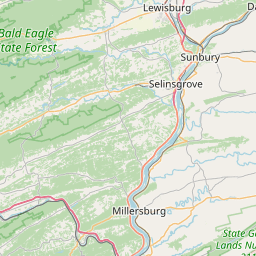
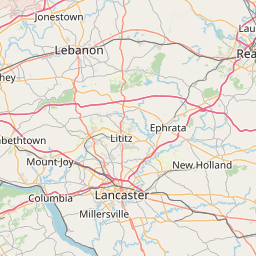
Pennsylvania has some of the highest radon levels in the country. The EPA has mapped much of the state as Zone 1, meaning the average indoor radon level is predicted to be above the action level of 4 picocuries per liter. York County sits squarely in that zone. The geology here, with its limestone and shale formations, creates conditions that allow radon gas to move easily through the soil and into homes.
I have seen houses built on the same street with wildly different radon readings. One home might test at 2 pCi/L, while the neighbor's basement reads 15 pCi/L. That variability is why you cannot rely on your neighbor's test results. You need your own data. Radon testing York County properties is not a one-size-fits-all exercise. Each house has its own footprint, foundation type, and ventilation patterns.
The Right Way to Test
Many homeowners grab a radon test kit from the local hardware store, set it in the basement for two days, and call it done. That is better than nothing, but it misses the full picture. Short-term tests can be thrown off by weather, open windows, or even fans running in the space. The EPA recommends that if you use a short-term test, you should close windows and doors at least 12 hours before starting and keep them closed for the duration of the test. Even then, a single short-term test is just a snapshot.
A more reliable approach is to use a long-term test, which stays in place for three months to a year. Those results average out the daily and seasonal swings and give you a much truer sense of your annual exposure. Many local health departments and some certified radon mitigators offer long-term test kits at a reasonable price. Dan Jenkins, a local radon contractor I have worked with, recommends doing a long-term test before deciding on any mitigation steps.
When I finally did my own radon testing in York County the right way, I used both a short-term test for a quick baseline and then a long-term test for confirmation. The short-term test came back at 6.2 pCi/L. The long-term test averaged out to 5.8 pCi/L. Both were above the EPA action level. That is when I knew I needed a mitigation system.
What Happens After a High Test Result
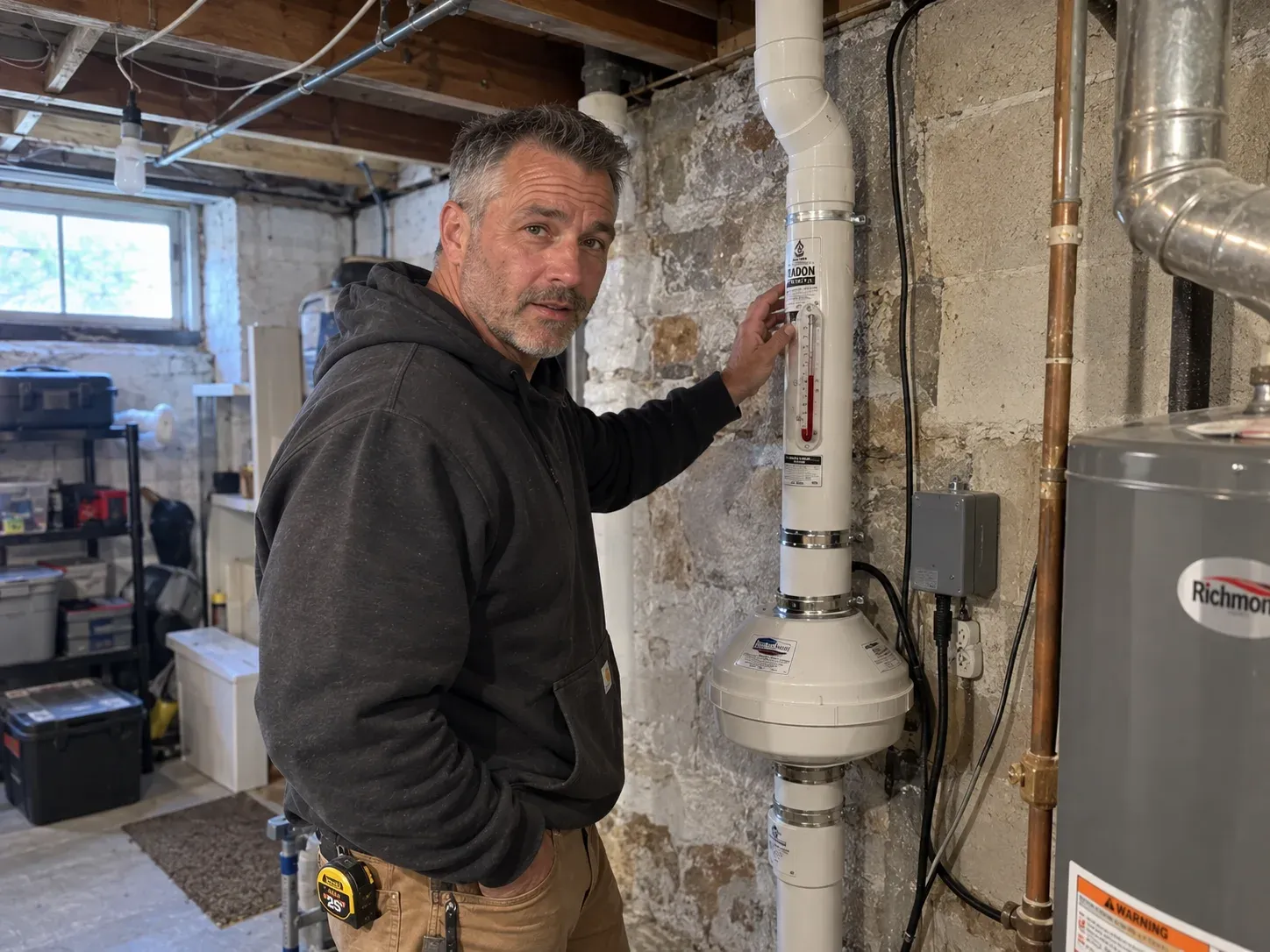
If your test comes back above 4 pCi/L, the EPA recommends taking action to reduce the level. That does not automatically mean you need a full radon mitigation system, but for most homes in York County with elevated readings, a professionally installed system is the most reliable fix. The most common method is sub-slab depressurization. It involves running PVC piping from a hole drilled through the basement floor up to a fan unit installed outside the living space. The fan creates a vacuum under the slab, pulling radon gas away from the house and venting it safely above the roofline.
A well-designed system also includes a manometer, which is a simple U-tube gauge that shows whether the fan is running and pulling the right pressure. You can check it with a glance. If the liquid in the manometer is level, the fan has stopped or the system has a leak. That visual check gives homeowners confidence that the system is still working years after installation.
Sealing radon entry points is another part of the process. Cracks in the basement floor, gaps around utility lines, and openings in the crawl space walls are sealed with a durable sealant. But sealing alone is rarely enough. Radon gas can still push through concrete and find the smallest gaps. That is why a fan-based system is usually the standard recommendation from a certified radon mitigator.
Post-Mitigation Testing Matters
After installing a radon mitigation system, you should never assume the problem is solved. A post-mitigation test is the only way to confirm that the system is actually lowering radon levels. The EPA recommends testing again within 30 days of installation. If the levels are still above 4 pCi/L, the system may need adjustment or the contractor may need to revisit the design.
I have seen cases where a homeowner skipped the post-mitigation test because the numbers on the manometer looked fine. Months later, a routine test showed the radon level had crept back up because the fan unit was undersized for the square footage. That is a costly oversight. A good radon contractor will include a post-mitigation test as part of the installation service. If they do not, ask for one.
Choosing a Contractor
Not everyone who offers radon testing and mitigation is equally qualified. Pennsylvania does not require a state license for radon contractors, but the National Radon Proficiency Program (NRPP) and the National Radon Safety Board (NRSB) offer certifications that require training and passing an exam. A certified radon mitigator will know how to design a system that fits your home's specific layout and soil conditions.
When I was looking for help, I asked about their experience with sub-slab depressurization in homes with crawl spaces. I also asked whether they would use a manometer and what kind of warranty they offered on the fan unit. A confident contractor should answer those questions without hesitation. Dan Jenkins, for example, provides transparent pricing and walks homeowners through the entire process from the initial test to the final post-mitigation check.
The Bigger Picture
Radon is the second leading cause of lung cancer in the United States, according to the EPA. It is a serious health risk, but it is also a fixable one. The first step is knowing your number, and that starts with proper radon testing in York County. Whether you do it yourself with a long-term test kit or hire a professional, the important thing is to actually do it. Ignorance is not protection.
If your radon levels come back high, do not panic. Mitigation systems are proven technology. They work. The cost is reasonable compared to the health risk, and many systems pay for themselves in improved home value and peace of mind. The key is acting on the information rather than filing it away and forgetting about it.
I keep a log of my radon readings now. I test every two years, and I check the manometer every few months. It takes thirty seconds. That small habit gives me confidence that my family is breathing cleaner air. Radon testing York County homeowners should treat it the same way they treat a smoke detector test or a furnace filter change. It is routine maintenance for a hidden hazard.
If you live in York County and have never tested your home, or if it has been more than two years since your last test, now is a good time to start. The test kit is cheap. The knowledge is priceless. And if the numbers call for action, there are experienced professionals ready to help.
Ends · GETRADONTESTINGYORKCOUNTYNEST